Your whole health in one app.
Food, diet, workouts, sleep and fluids all in one place — and, whenever you want, your labs and medications too. It's the 360 view no diet app gives you.
10 crossed modules4 layers: food, workout, sleep, clinical1 dashboard
Every app of yours is an island.
Food in one app, workout in another, sleep on the watch, labs in your email. None of them talk to each other — and the answer lives exactly at that intersection. Bad sleep tanks your workout, the workout changes your hunger, hunger changes your weight. On separate screens, you never see it.
Everything you log every day, in seconds.
Food and diet
A photo of your plate becomes calories and macros. Barcode for packaged food. A photo of your nutritionist's plan becomes a per-meal target — and the app shows your adherence to it, meal by meal.
Workout and cardio
A photo of your routine becomes a structured workout, with load, 1RM and rest timer. Cardio comes in with calories deducted from the day's goal.
Sleep, fluids and weight
Hours, quality and HRV. Water and other drinks by type. Weight and body composition — the calorie target adjusts itself as your real weight moves, instead of staying at a fixed number calculated once.
And then the app ties it all together
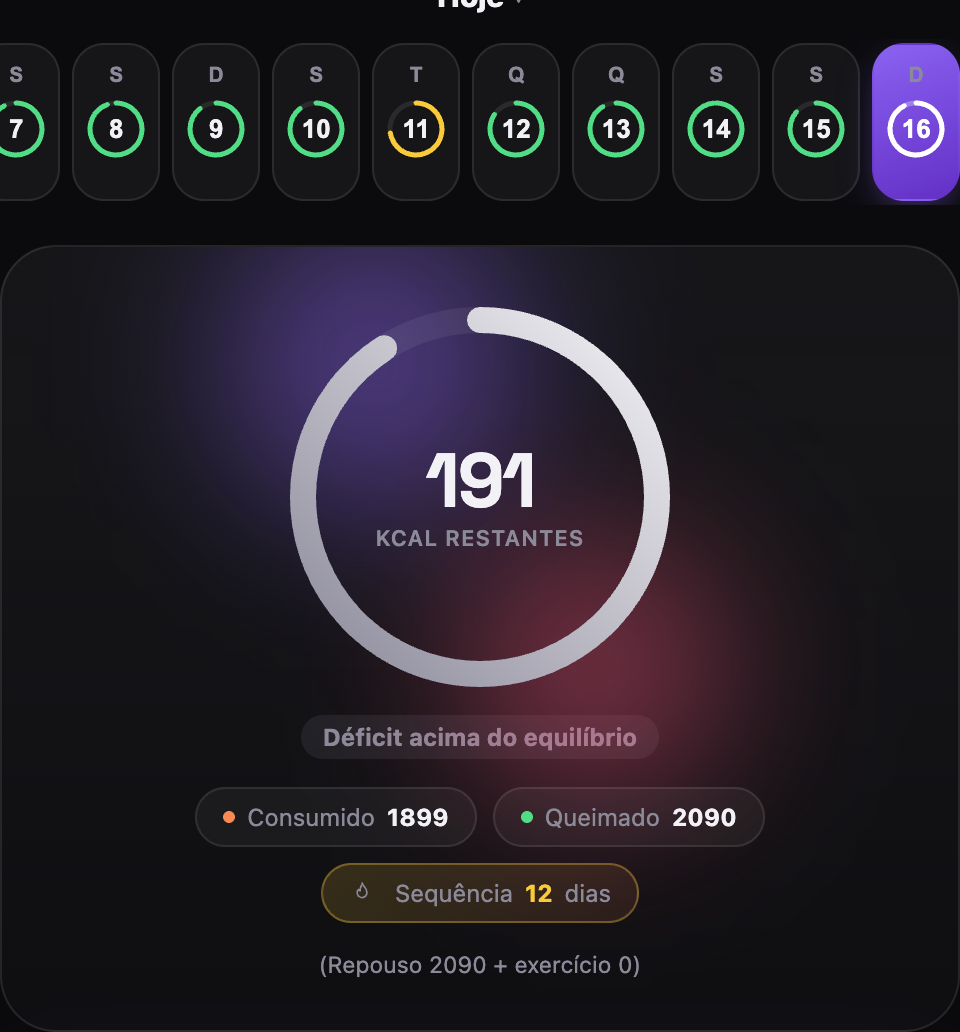
A daily dashboard, weekly trends and an on-demand analysis that reads every module at once. Not a per-screen summary — a read of the whole picture.
FoodDietWorkoutCardioSleepWaterWeightFastingTrendsInsights
And then come your labs and medications.
This is where Merid stops being a diet app. A photo or PDF of your labs becomes a historical series for each marker. What you take — supplement or medication — goes in the same place, with interactions between formulas. With that, the loop closes — what we call the Iron Protocol:
Merid doesn't prescribe.
It doesn't recommend a dose, tell you to start or stop a medication, or claim causation. It shows the pattern, the sample size and the timeline. The decision is yours and your doctor's.
Why you can't build this with three apps.
| Other apps | Merid | |
|---|---|---|
| Food, workout, sleep and fluids | each in its own app | one dashboard |
| Photo of your plate | separate paid plan | included |
| Calorie target | fixed, calculated once | adjusts to your real weight |
| Nutritionist's plan | don't have it | per-meal adherence |
| Intermittent fasting | just a timer | cross-referenced with sleep and HRV |
| Blood work | don't have it | series + retest timeline |
| Medication and interactions | don't have it | same place |
Five questions and you know which plan is yours
No sign-up, no email. Answers are stored only to sharpen the product — none of them is a clinical question.
Question 1 of 5
What do you want to solve first?
While access is early, everything is unlocked.
Billing coming soonFreeR$ 0
- ✓Sleep, water, weight and profile
- ✓5 AI analyses per day
BasicR$ 14,99 /mêsor R$149.99/year
- ✓Food, workout and cardio with AI
- ✓Insights and suggestions
- ✓50 analyses per day
ProR$ 24,99 /mêsor R$199.99/year
- ✓Everything in Basic
- ✓Labs and the clinical loop
- ✓Medications and interactions
- ✓100 analyses per day
Nothing is charged today. When billing opens, you'll be notified beforehand — no card locked in now.
Not for everyone yet.
Merid is in controlled access: you request entry and approval is manual. That's intentional — the product reads health data, and I'd rather grow slow than grow wrong.
How much does your body burn at rest?
This is the same math that runs inside Merid — free here, no sign-up. Fill it in and see it instantly.
Fill in all four fields to see the result.
What people ask before signing up
Do I need blood work to use it?
No. Food, training, cardio, sleep, water and weight work on their own, and that is where most people stay. Blood work, medication and glucose are layers you switch on when you want — they make the app sharper, not necessary.
I have never logged anything. Is it worth starting from zero?
Yes, and the app says plainly when it does not yet have enough history to conclude something, instead of inventing an analysis from three days of data. The first readings show up in week one; the ones that cross modules need more history.
I have used a diet app for years. What changes?
The crossing. A diet app counts calories; here the same week of food is read alongside your sleep, your training and — if you want — your latest blood work. That is the question no food diary answers on its own.
Does Merid replace a doctor, dietitian or trainer?
No, and it is built not to try. It does not prescribe a dose, a treatment, a fixed diet or a training load, and it does not claim causation. It shows the pattern in what you logged and, when the data calls for it, explicitly tells you to take it to a professional.
Where is my health data stored?
In our own database, tied to your account, and it is never sold or shared with third parties for advertising. You can request account and data deletion at any time — details in the privacy policy.
Do I need a watch or a smart scale?
No. Everything can be logged by hand, and that is how the app was designed. If you have Apple Health or Health Connect, you can import sleep and exercise instead of typing.
One less app on your phone. One more view of your health.
Request accessAlready have an account? Sign in